
Pixel Manager for WooCommerce 1.58.8



- Secure Payment
- Support Monday to Friday
- With You Since 2018
$149.00 The original price was: $149.00.$6.99The current price is: $6.99.
quick summary
Pixel Manager for WooCommerce centralizes and organizes conversion tracking for your WordPress store. It's designed for those who invest in advertising, need reliable data, and want to know which ads are actually selling. Avoid scattered pixel configurations, missed sales, and decisions based on incomplete statistics by concentrating control of purchase events and user behavior in a single dashboard within WooCommerce.
What problem does it help solve?
The problem isn't "having a pixel installed," but rather having dirty, duplicate, or incomplete data that distorts your campaigns. In an e-commerce site using WooCommerce, it's common to connect ads across different platforms, test remarketing, and configure events from each channel separately. This often leads to chaos: purchases recorded twice, abandoned carts missing from reports, and metrics that never match across dashboards.
If you've ever noticed your ad dashboard showing more conversions than actual orders in WooCommerce, or vice versa, the problem lies in poorly orchestrated tracking. In real-world projects, this discrepancy leads to poor decisions: profitable campaigns are canceled, budgets are increased for ads that aren't generating sales, or successful audiences are left unoptimized. Pixel Manager for WooCommerce addresses this very issue: it unifies and standardizes how key events in your store are triggered.
This happens when the business grows and you start adding more marketing platforms, more experiments, and more manual scripts inserted by different people. Without centralized tracking management, every change to the theme, page builder, or checkout funnel becomes a risk to measurement. The result is a constant feeling of uncertainty about which data is accurate and which campaign is actually generating revenue.
Why this solution makes a difference
Pixel Manager for WooCommerce is more than just "adding code." Its role is to structure the triggering of e-commerce events directly from WooCommerce, ensuring that different ad platforms receive consistent information. Instead of having each script running independently, it acts as an orchestrator: it knows when an order is completed, a cart is being processed, or any other relevant action occurs in the store, and it communicates this information seamlessly.
In day-to-day operations, this means less time spent investigating why one platform is registering conversions while another isn't, and more focus on fine-tuning campaigns with reliable data. When you start noticing that you're spending more time tweaking tracking configurations than optimizing ads, introducing a central pixel manager completely changes the workflow. You stop relying on small fixes and return to working with a clear logic: WooCommerce is the source of truth, and events are sent from there.
Furthermore, when working with WordPress, every theme update, design change, or new funnel can affect scripts manually placed in different templates. By centralizing the tracking logic in Pixel Manager for WooCommerce, you reduce the chances of breaking your metrics with frontend modifications, because the core data is based on the actual WooCommerce order flow, not on code snippets scattered throughout the site.
Signs you need this product
- Your ad platform reports don't match your WooCommerce sales data, and you don't know which one to believe.
- You'll notice friction in WordPress every time you want to add or change a pixel, because it depends on different plugins, templates, or snippets.
- You've lost control of the tracking: you don't remember where each script is inserted and you're afraid of breaking something when making changes.
- Your online store has gone from few sales per month to a stable volume, and you need to measure more accurately which campaigns are driving that growth.
- If you've ever changed your checkout design and suddenly your conversions "disappeared" from your advertising reports, you've reached the point where a unified pixel manager stops being a luxury and becomes a key component.
When does it make sense to use it (and when doesn't)
Pixel Manager for WooCommerce delivers real value when your sales strategy relies on paid advertising, remarketing, or detailed conversion analytics. If you use multiple ad platforms, work with measurable funnels, and need to optimize cost per acquisition, having centralized tracking control isn't just an add-on, it's essential to avoid wasting your budget.
It's also ideal when you manage client stores and need a clear and replicable system to ensure that purchase and behavioral events are always recorded in the same way. In that context, it reduces reliance on theme-specific manual configurations and gives you a more stable foundation for working with any layout.
On the other hand, if your WordPress site only displays a catalog without a complete checkout process, or if you don't run ad campaigns or need detailed sales attribution, Pixel Manager for WooCommerce won't make a radical difference. In those situations, a simple, basic tracking script might suffice, and a specialized pixel manager for WooCommerce would be overkill for your project at that stage.
Who it fits best for
- WooCommerce store owners who consistently invest in advertising and need to clearly understand which campaigns generate orders.
- Marketing agencies and consultants that manage multiple WordPress ecommerce sites are looking for an organized system to handle conversions without relying on scattered scripts.
- Projects in the scaling phase, where the volume of traffic and sales justifies a fine measurement of the performance of each advertising channel.
- Internal marketing teams that work closely with the technical area and require a common point of reference to validate data before adjusting budgets.
- Developers who create stores for clients and want to leave a stable tracking system, based on native WooCommerce events, instead of makeshift solutions.
Practical benefits
- Real operational improvement: centralizes the triggering of purchase and behavior events, avoiding duplication and gaps in data collection.
- User experience: It allows you to review and organize measurement from a single place associated with WooCommerce, without having to track down code snippets in different sections of the theme.
- Control and organization: It facilitates a clear structure of what is being measured, where and how, which simplifies collaboration between the technical team and marketing managers.
- Time savings: reduces hours spent auditing discrepancies between reports, correcting pixel settings, and redoing measurements after design changes.
- Error reduction: By relying on WooCommerce's internal order and event flow, it reduces the likelihood of a frontend adjustment breaking conversion tracking.
How it fits within WordPress
Within the WordPress ecosystem, Pixel Manager for WooCommerce operates at the business level, not the design level. While the theme and page builder handle the store's appearance, this manager aligns with the WooCommerce core to determine which actions are meaningful: product views, items added to cart, checkout initiations, or completed orders. From this perspective, it acts as a bridge between your store and advertising platforms.
In terms of workflow, the admin panel remains the central hub for daily order and product management, and Pixel Manager for WooCommerce integrates seamlessly into this process, adding an extra layer of structured measurement. This means that when designing new landing pages, testing alternative funnels, or modifying checkout processes, tracking depends less on button placement and more on how WooCommerce processes the action, thus providing stability to the measurement system.
Common usage scenarios
- A fashion store on WooCommerce that runs simultaneous campaigns across multiple advertising networks needs to accurately attribute which channels drive sales for each product line.
- An online training project that sells courses through WooCommerce needs to measure in detail which ads and creatives lead to completed purchases, not just visits to course pages.
- An ecommerce site that has gone from few monthly transactions to a considerable daily volume and is starting to build remarketing funnels, lookalike audiences, and advanced segmentations based on events.
- A business that works with an external marketing agency, where Pixel Manager for WooCommerce becomes the shared reference to analyze whether the conversion data sent to the platforms is consistent with the actual orders.
- A store that migrated its theme and, after the change, lost some tracking; by incorporating this manager, it once again supports measurement in internal WooCommerce events instead of depending on scripts inserted in old templates.
Frequently Asked Questions about Pixel Manager for WooCommerce
What differentiates Pixel Manager for WooCommerce from adding pixels manually?
When adding codes manually, each pixel depends on its exact location: theme template, visual builder, or header snippet. Any design change can alter its behavior. Pixel Manager for WooCommerce relies on WooCommerce's internal events, not specific HTML positions. This way, purchase, cart, and checkout events are triggered based on the actual order flow, reducing errors and data discrepancies between platforms.
How does Pixel Manager for WooCommerce help improve my advertising campaigns?
When your campaigns are based on well-measured conversions, ad platforms can optimize for actual buyers, not irrelevant clicks. Pixel Manager for WooCommerce coordinates order and behavior data so that each platform receives consistent information. This allows you to more clearly identify which ads are associated with sales, adjust bids more confidently, and eliminate ineffective creatives. The practical result is more informed decision-making and less wasted budget.
What happens if I change the theme or update my store's design?
In a scenario with scripts scattered across theme templates, any design change can break part of the tracking, even without you noticing immediately. With Pixel Manager for WooCommerce, measurement is primarily related to the WooCommerce order flow. This means that even if the visual appearance is refreshed or the product presentation is modified, the event triggering logic remains anchored to the store's internal behavior, maintaining data consistency.
Is Pixel Manager for WooCommerce useful if I only have one ad platform?
Even when working with a single advertising channel, Pixel Manager for WooCommerce brings order and stability to your measurement. It allows you to organize key events directly from WooCommerce without relying on isolated scripts, simplifying maintenance as your store evolves. When you later add new channels or remarketing strategies, you'll already have a consistent database, preventing you from having to completely redo your tracking setup during periods of growth.
What kind of data problems does Pixel Manager for WooCommerce help prevent in WooCommerce?
In stores without a central pixel manager, errors such as duplicate conversions, unregistered orders in certain campaigns, events triggered at incorrect times, and abandoned carts that never appear in the metrics can occur. Pixel Manager for WooCommerce reduces these errors by structuring measurement based on the WooCommerce order system. This way, tracking is focused on what truly matters: what is being sold, when, and through what user behavior, minimizing distortions.
Conclusion
Pixel Manager for WooCommerce exists to solve a very specific problem: the lack of consistency in conversion tracking for WordPress stores. It focuses measurement on actual WooCommerce events and distributes that information systematically to advertising platforms. If your business relies on reliable data to decide where to invest in advertising, this tool helps you solidify the numerical foundation upon which your daily marketing decisions are based.
Last updated:

Written by: WPClub
With over seven years of experience curating, managing, and distributing GPL products, our content is based on hands-on experience, technical review, testing, and feedback from thousands of users. We aim to democratize and simplify the WordPress world so you can choose with confidence, speed, and ease.
Your Individual Purchase Includes:
- Lifetime updates.*
- Official product, ready to use.
- Immediate access to the product.
- Clean and virus-free files.
- GNU GPL V2/V3 License
- Technical support in Spanish and English.
* In the case of memberships, the period during which you will receive updates will depend on the type of membership purchased: monthly, annual, or lifetime.
Notify Update
We update products Monday through Friday. However, if the product you see is not yet updated, you can notify us so we can prioritize updating it whenever possible.
Get rid of your doubts here
Here you'll find answers to frequently asked questions about our service: how it works, what it includes, and how to get the most out of it.
How many websites can I use the products on?
You can use any product from our store on as many websites as you like.
Will I get updates?
Absolutely. If you buy an individual product, you'll get lifetime updates for that product.
On the other hand, if you purchase a membership, you will have updates until your membership expires.
What if I have a problem?
First of all, we want you to know that you can count on us. We will assist you and provide the necessary support, so you can rest assured.
On the other hand, it is important for you to know that, given the time difference between countries, your time and ours may not be the same, so we will be delayed accordingly.
Our opening hours start at 09 AM from Monday to Friday, UTC -3. We are open until around 18 PM.
Do you provide technical support?
Yes, and regarding time, it is usually on average within 24 to 48 business hours.
However, there are times when we have already provided a response and solution in less than a day depending on the case.
Are there download limits?
No. We don't believe in that format, so you can download as many times as you want. No problem. We pay for high-quality professional storage precisely to avoid problems.
Do you provide license keys?
No. Giving out the keys is not a viable option, as we have had experiences where they end up circulating everywhere and we can even lose the associated accounts.
That said, all products are original and, in cases where a license key is required to function, we will take care of pre-activating them for you.
Does my purchase include an invoice?
Yes. After paying, you will be able to immediately access your invoice in the “Purchases” section of your user account.
This is why it is important that you properly complete the information requested at the time of payment.
Is there a warranty?
Yes, of course. If there's a problem we can't resolve, or if there's an external issue that doesn't have a general solution, you'll receive support and, if necessary, a full refund. We have a 14-day refund policy from the date of purchase.
- It is worth noting that there is no guarantee if the product works well and simply was not what you wanted.
There have been times when a person buys a product, the product works perfectly, but they don't like it and want a refund, keeping the product. That is not appropriate.
Now, everything is evaluable and reasonable. Let's use the criteria together.
What is the attention hour?
Our opening hours are:
- Monday to Friday, from 09 a.m. to 18 p.m.
- Saturday and Sunday: No service.
UTC -3 time

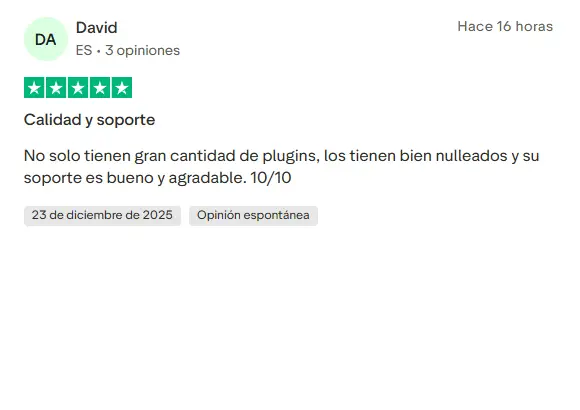
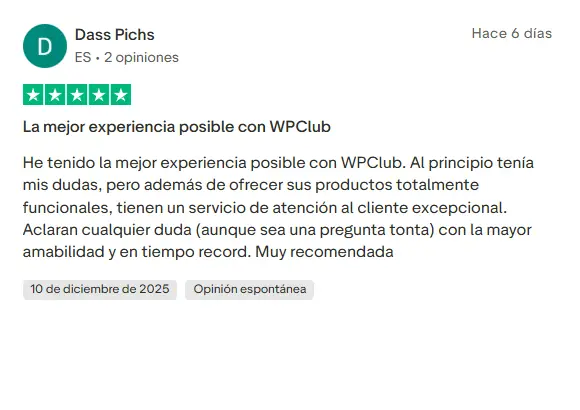
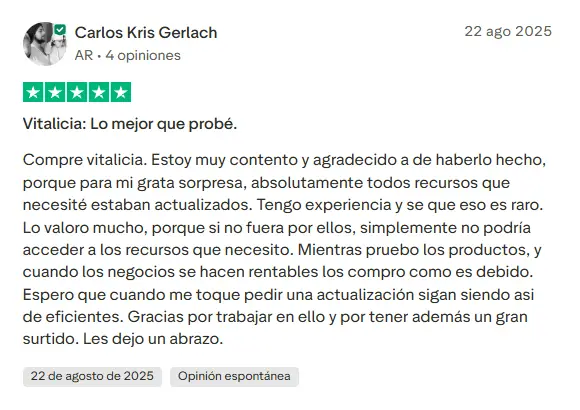
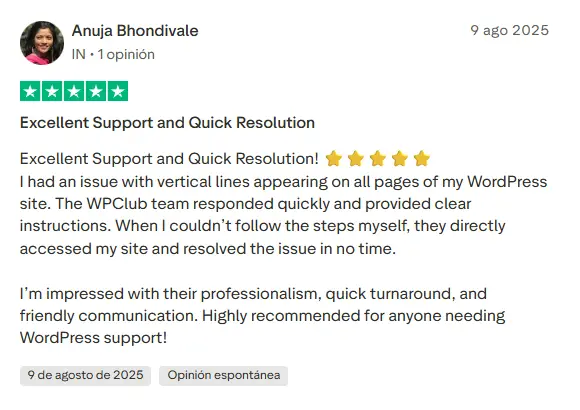
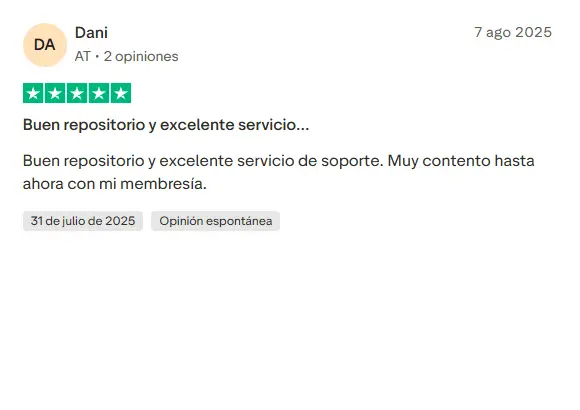
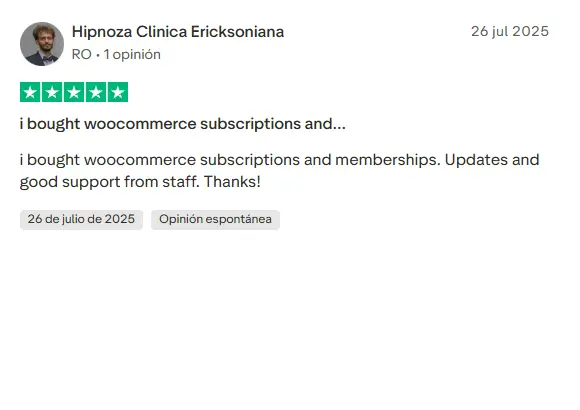
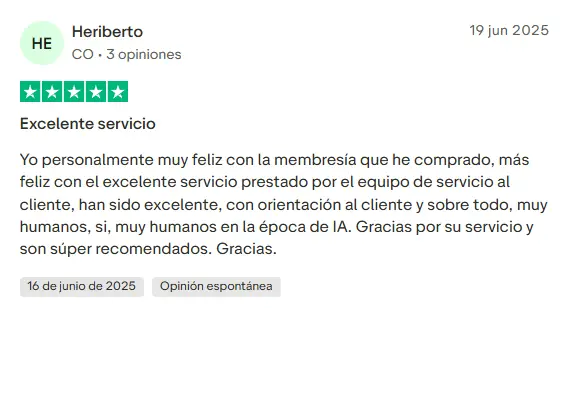
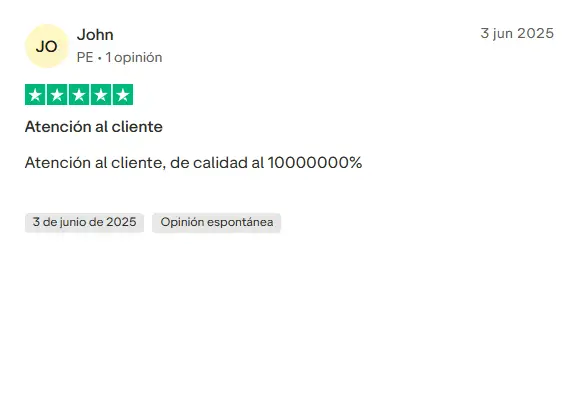
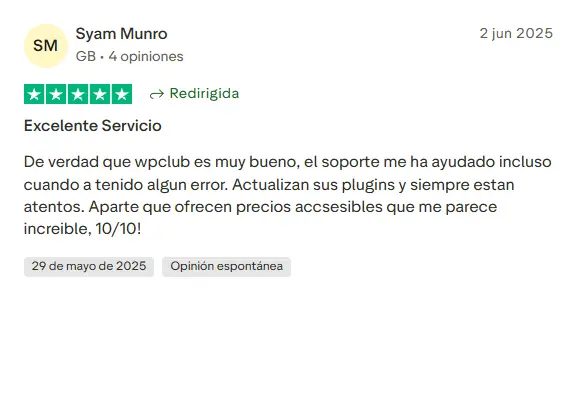
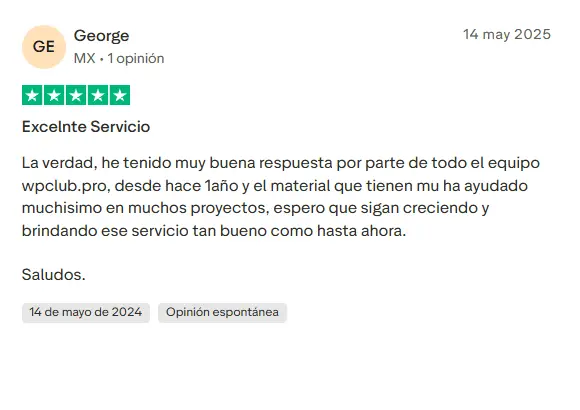
Our Reputation on Trustpilot
Many thanks to those who take the time to give us a review. Trustpilot. Each of your comments is very helpful. We strive to provide a rewarding experience for each member of our community, always with respect and love. We will be here!











WPClub Memberships
Access our entire catalog for a single payment. We offer three memberships: Monthly, Annual, and Lifetime (One-Time Payment).
- Save thousands of dollars
- No daily download limits
- No recurring payments
- Fast Downloads by AWS
- Quality service and support, validated since 2018
- We work with love for our community