

- Secure payment
- Spanish and English support
- With you since 2018
WP Plugin Manager Pro 1.4.6
$19.00 El precio original era: $19.00.$5.99El precio actual es: $5.99.
Quick summary
WP Plugin Manager Pro is a plugin designed for those who need to activate and deactivate WordPress extensions in a granular and organized way without losing control over performance. It is especially useful on sites with many installed modules, where managing what loads and when starts to impact speed, stability, and daily maintenance, both on client projects and growing personal projects.
What problem does it help solve?
On WordPress sites that have grown over time, it's common to accumulate dozens of active plugins "just in case." Each new feature adds code, queries, and files that affect performance, even if they aren't used on every page. When you start noticing that the dashboard is slow, that certain sections of the site are loading late, or that conflicts arise between extensions, the cause is usually imprecise management of what's running in each part of the project.
If you've ever experienced a module breaking a specific page and you don't want to disable it site-wide because you need it in another section, the problem is clear: there's a missing layer of control between "active" and "deactivated." Without this management layer, every adjustment involves endless manual testing, fear of changing anything in production, and heavy maintenance, especially when managing online stores or websites with constant traffic.
WP Plugin Manager Pro addresses precisely this bottleneck: it allows you to decide which extensions run based on content type, sections, or defined rules, preventing WordPress from loading unnecessary parts in areas where they don't contribute anything. In real-world projects, this organization translates into fewer conflicts, less time spent troubleshooting, and greater clarity about what's happening in the background.
Why this solution makes a difference
The main change introduced by WP Plugin Manager Pro is the ability to manage the functional "weight" of your site without having to give up the extensions you need. Instead of uninstalling plugins every time something becomes slow, you can organize what runs on the homepage, what is reserved for the private area, what will only affect certain sections, and what parts should never load during the checkout process.
In day-to-day operations, this reduces improvised decisions and emergency adjustments. When a client requests a new feature, you don't have to choose between performance and flexibility: you can limit its scope with clear rules from a single dashboard. Furthermore, with a more organized view of what's active and where, identifying the source of a conflict is no longer an hours-consuming trial-and-error process. The result is a smoother workflow, fewer technical interruptions, and a more responsive site without requiring a complete overhaul of the project.
Signs you need this product
- Problem already present on the site: There are specific pages that are very slow or unstable, but you can't disable the plugins involved because they are needed in other key sections of the project.
- Friction in WordPress or WooCommerce: This occurs when you make minor changes and suddenly the purchase process, user area, or editor starts to fail for no apparent reason.
- Loss of control or time: To detect a conflict, you end up disabling extensions one by one, manually testing and noting combinations, which delays deliveries and maintenance tasks.
- Typical growth scenario: You manage a store or portal with many specific functionalities (marketing, optimization, memberships, bookings) and you want to continue expanding without turning the site into a difficult-to-maintain structure.
When does it make sense to use it (and when doesn't)
WP Plugin Manager Pro provides real value when the number of installed extensions starts impacting performance, stability, or daily project management. It makes sense to incorporate it into the workflow of websites that combine several advanced features: e-commerce, private areas, automations, booking systems, or custom content spaces. It's also a good fit when you need more controlled testing environments without replicating the entire site in an external environment.
On the other hand, it's not particularly necessary for very simple projects with few extensions and minimal functional changes. If your site is a basic corporate website with a handful of well-chosen modules and you barely notice slow loading times or issues, adding an extra management layer won't provide a noticeable improvement. In that context, the key is to keep the installation lightweight and periodically review what's still useful, without needing advanced load management.
Who it fits best for
- WordPress Implementers and Developers: Professionals who manage several projects in parallel and need an organized way to control what runs in each environment without wasting time on endless manual testing.
- Online stores and projects with WooCommerce: Sites where the purchasing process, the catalog, and the customer area coexist with many additional functions, and where any slowdown directly impacts sales and internal support.
- Agencies and in-house marketing teams: When the team incorporates new modules to measure, optimize, or launch campaigns, the accumulation of functionalities begins to affect the browsing experience and daily management work.
Practical benefits
- Real operational improvement: The granular organization of what is executed in each section reduces bottlenecks and simplifies diagnostics, avoiding long stoppages due to unforeseen failures in key areas of the project.
- User experience: By limiting the loading of extensions where they don't add value, pages feel lighter and the admin panel is more responsive, making tasks like content editing or order management easier.
- Control and organization: Having a central panel where you can see what is active and under what conditions allows you to make decisions based on a clear vision, not on assumptions or endless trial and error processes.
- Time saving: When you've already spent hours deactivating and activating modules to locate a conflict, having defined rules reduces that repetitive work and frees up time for higher-value tasks.
- Error reduction: Minimizing unnecessary functionality load reduces the chances of conflicts between extensions that should never coincide on certain pages, preventing errors that affect the end user's experience.
How it fits within WordPress
WP Plugin Manager Pro integrates seamlessly into the natural workflow of WordPress project managers. Rather than acting as an extension that adds a feature visible to visitors, it focuses on the internal management layer: it allows you to define rules about what runs in each part of the site and keep that configuration under control from the dashboard. In this context, it doesn't replace your existing functionalities but rather serves as an organizational layer on top of them.
Within a typical workflow, it's used when planning new sections, preparing significant changes, or diagnosing issues without affecting the entire project. Its role isn't to do more work on the website, but to help you decide what should be active at any given time and where, keeping performance and stability as top priorities in your decision-making.
Typical use cases
- Real-world use in ecommerce: A store with many features (payment methods, points programs, popups, tracking tools) where only certain functions are of interest on the product page or at checkout, and the aim is to prevent the rest from affecting the purchase process.
- Specific case study: A content portal with a public and a private area, where some extensions are only required for registered users. Managing what is uploaded to each area helps keep the public area fast without sacrificing internal complexity.
- Situation where it provides direct value: Project with multiple test extensions, temporary campaigns, or integrations that only need to be present in certain sections or during a specific period, without redoing the site architecture or duplicating installations.
Frequently Asked Questions about WP Plugin Manager Pro
How does WP Plugin Manager Pro differ from simply activating or deactivating extensions from the standard panel?
The native WordPress dashboard only offers two states: active or inactive, always applied to the entire site. WP Plugin Manager Pro introduces an intermediate level of control, allowing you to define rules about where and when each plugin runs. This way, instead of completely disabling a feature because it causes problems on a specific page, you can keep it available in the sections where it truly adds value, avoiding unnecessary impacts on the rest of the website.
How does WP Plugin Manager Pro help locate conflicts between extensions on a complex site?
When a conflict causes errors on certain pages, the usual process involves disabling extensions one by one until the problematic combination is found. With WP Plugin Manager, you can adjust the loading of each module by section, reducing the number of elements involved in the conflict. This makes it easier to isolate which extension is causing the problem, since you work with more specific rules and loading groups, without affecting the rest of the project or impacting areas that are still functioning correctly.
Is WP Plugin Manager Pro useful if I manage multiple WordPress projects at the same time?
In environments with multiple websites under maintenance, the time spent on diagnostics and adjustments multiplies. WP Plugin Manager Pro allows you to standardize how you manage plugin loading across each project, enabling you to adopt a clear methodology: what runs on the public-facing side, what is restricted to specific sections, and what is avoided in critical processes. This approach facilitates documenting technical decisions and replicating best practices across projects, reducing improvisation when addressing each issue.
Can WP Plugin Manager Pro improve the editing and management experience within the WordPress dashboard?
On sites with many active extensions, the admin area can become slow or unstable, affecting basic tasks like editing pages, managing orders, or reviewing statistics. By limiting which modules run in certain areas or contexts, WP Plugin Manager Pro helps make the dashboard more responsive. This is especially noticeable when there are resource-intensive tools that are only needed for specific actions and don't need to be active on every screen of the admin area.
Does it make sense to use WP Plugin Manager Pro on a new website or one that is still under construction?
On a website still under construction, WP Plugin Manager Pro helps establish an organized plugin loading structure from the outset. You can define what will run in each part of the project as you build it, instead of accumulating features without a clear strategy. This way, when the site grows in traffic and functionality, you already have a control layer in place, avoiding the need to reorganize everything later to fix performance or stability issues.
Conclusion
WP Plugin Manager Pro exists to address a very specific problem: WordPress sites that need a lot of functionality, but also fine-tuned control over what runs in each part of the project. If your daily work involves resolving issues caused by extension conflicts, slow pages with no apparent cause, or endless manual testing, incorporating a load management layer can be a game-changer in your workflow.
When the project is simple, a few well-made decisions are all it takes. But as your website grows, detailed load control becomes a real advantage. That's where WP Plugin Manager Pro brings order, clarity, and smoother management of your WordPress plugin ecosystem.
Your individual purchase includes:
- Lifetime updates.*
- Product ready to use.
- Immediate access to the product.
- Clean and virus-free files.
- GNU GPL V2/V3 License
- Technical support in Spanish and English.
* In the case of memberships, the period during which you will receive updates will depend on the type of membership purchased: monthly, annual, or lifetime.
Get your questions answered here
Here you'll find answers to frequently asked questions about our service: how it works, what it includes, and how to get the most out of it.
On how many websites can I use the products?
You can use any product from our store on any website you want.
Will I get updates?
Absolutely. If you buy an individual product, you'll get lifetime updates for that product.
On the other hand, if you purchase a membership, you will receive updates until your membership expires.
What if I have a problem?
First of all, we want you to know that you can count on us. We will assist you and provide the necessary support, so you can rest assured.
On the other hand, it is important for you to know that, given the time difference between countries, your time and ours may not be the same, so we will be delayed accordingly.
Our opening hours start at 9 AM from Monday to Friday, UTC -3. We are open until around 6 PM.
Do they provide technical support?
Yes, and regarding the time, it is usually on average within 24 to 48 business hours.
However, there are times when we have already provided an answer and solution in less than a day, depending on the case.
Are there download limits?
No. We don't believe in that format, so you can download as many times as you want. No problem. We pay for high-quality professional storage precisely to avoid problems.
Do they provide license keys?
No. Giving out the keys is not a viable option, as we have had experiences where they end up circulating everywhere and we can even lose the associated accounts.
That said, all products are original and, in cases where a license key is required to function, we will take care of pre-activating them for you.
Does my purchase include an invoice?
Yes. After payment, you will be able to access your invoice immediately in the "Purchases" section of your user account.
That is why it is important that you properly complete the information requested at the time of payment.
Is there a warranty?
Yes, of course. If there's a problem we can't resolve, or if there's an external issue that doesn't have a general solution, you'll receive support and, if necessary, a full refund. We have a 14-day refund policy from the date of purchase.
- It should be noted that there is no warranty if the product works well and it simply wasn't what you wanted.
There have been instances where someone buys a product, the product works perfectly, but they don't like it and want a refund, keeping the product. That's not right.
However, everything is evaluable and reasonable. Let's use judgment together.
What are the opening hours?
Our opening hours are:
- Monday to Friday, from 9 a.m. to 6 p.m.
- Saturday and Sunday: No service.
UTC -3 time

Reviewed by the WPClub team
At WPClub, we carefully review each product before listing it. Our team evaluates its key features, compatibility, and performance to provide you with reliable, up-to-date, and helpful information when choosing and using each resource available in our store.
Download previous versions
If you have purchased this product, or have an active membership, you can download previous versions as we release them, without any limits or restrictions.
| Nombre del producto | Versión | Tamaño | Fecha | Descargar |
|---|---|---|---|---|
| No hay versiones anteriores registradas. | ||||

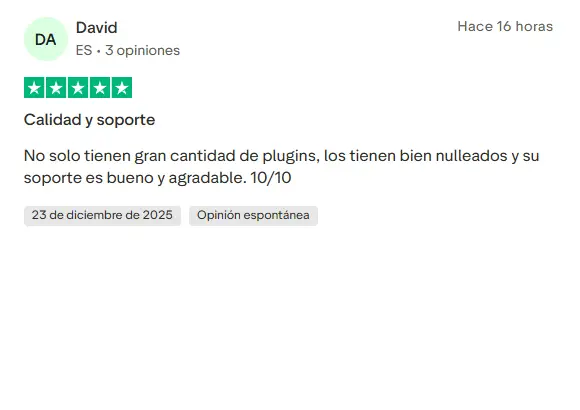
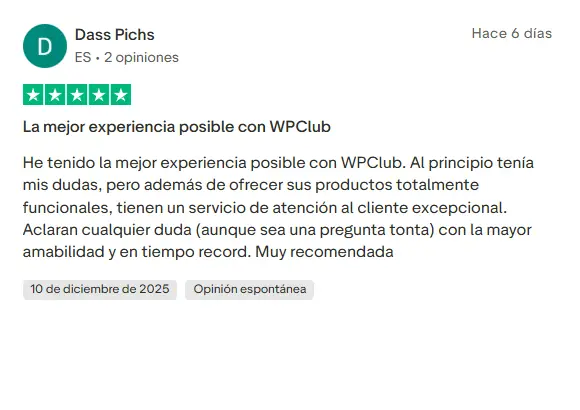
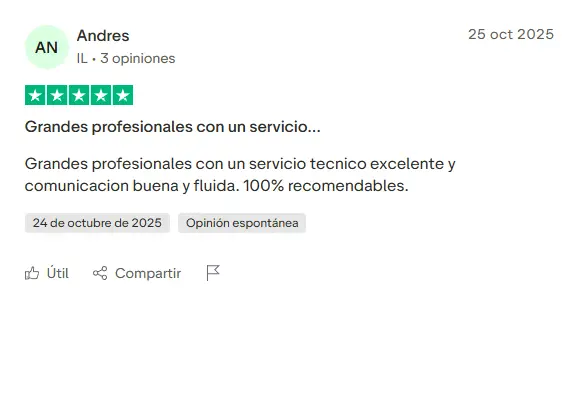
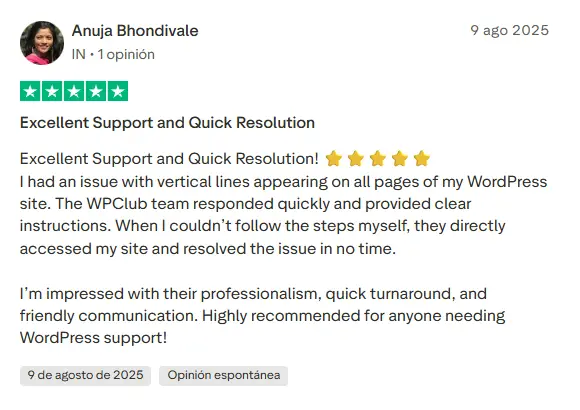
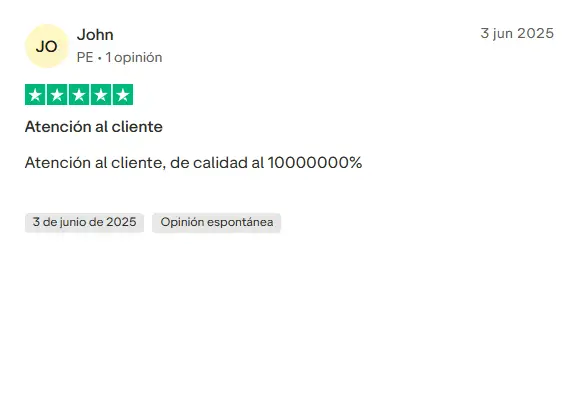
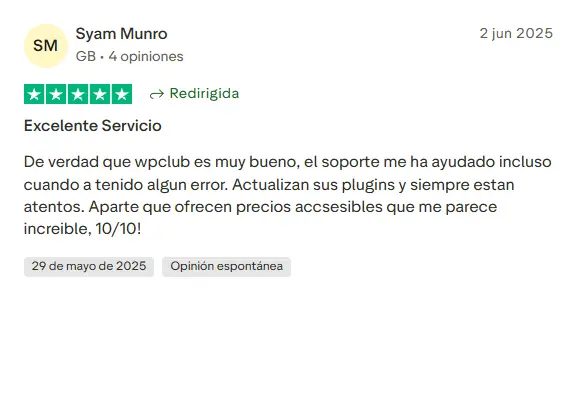
Our Reputation on Trustpilot
Many thanks to those who take the time to give us a rating on Trustpilot. Each and every one of your comments is very helpful to us. We strive to provide a rewarding experience for every member of our community, always with respect and care. We'll be here!













WPClub Memberships
Access our entire catalog for a single payment. We offer three memberships: Monthly, Annual, and Lifetime (One-Time Payment).
- Save thousands of dollars
- Unlimited daily downloads
- No recurring payments
- Fast downloads by AWS
- Quality service and support, validated since 2018
- We work with love for our community